
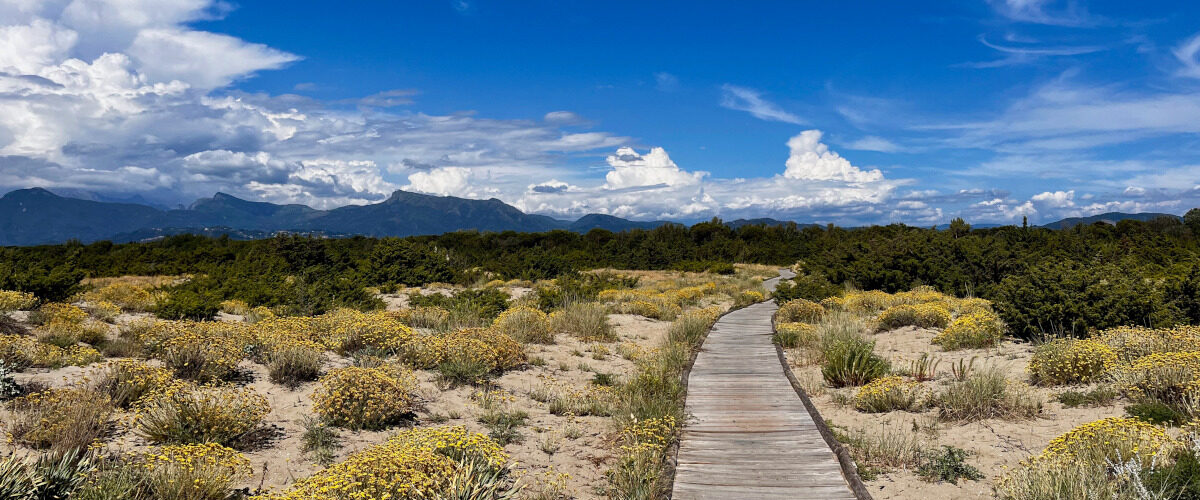
The Migliarino San Rossore Massaciuccoli Natural Park
The Migliarino San Rossore Massaciuccoli Natural Park, one of the largest and most fascinating coastal parks in Italy, preserves a unique heritage of history, landscapes, and biodiversity shaped over centuries by the complex relationship between humans and the environment.
It extends over more than 23,000 hectares, with an additional 9,000 hectares of the protected marine area of the Secche della Meloria, offering an exceptional natural heritage between sea, forests, and wetlands.
Its great historic estates—Migliarino, Tombolo, Coltano, and San Rossore—together with the Macchia Lucchese and Lake Massaciuccoli, tell a long story of land reclamation, forests, noble reserves, and today of sustainable nature tourism.
Discover our guided excursions in the San Rossore Park and experience nature with expert guides, among biodiversity, history, and unique landscapes.
The San Rossore Estate: Medici and Royal Reserve, Heart of the Park
The San Rossore Estate is the historical and symbolic core of the Park.
Frequented by humans since the Neolithic period, it became a vast Medici reserve in the 16th century, later Lorena and finally royal, used for hunting, livestock breeding, and royal leisure.
Here, centuries of hydraulic works were carried out to control the Arno River and inland waters, along with careful forest management that preserved lowland forests, pinewoods, wetlands, and coastal dunes. During the Savoy period, San Rossore experienced its most splendid era, becoming a center of excellence for horse breeding.
After World War II and its transfer to the Tuscany Region, the estate was gradually opened to the public and is now the park’s main visitor hub, with visitor centers, a racetrack, and guided routes on foot, by bike, on horseback, and by “tourist train”.
Migliarino Estate: From the Selva Palatina to a Coastal Park
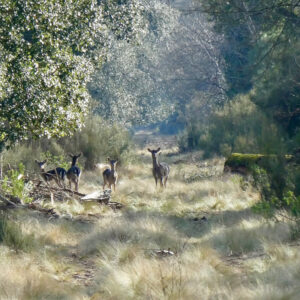
The Migliarino Estate stretches along the coastline between the mouth of the Serchio River and the historic border between Lucca and Pisa, largely coinciding with the ancient Selva Palatina, a vast coastal forest mentioned as early as the medieval period.
A harsh and unhealthy environment, characterized by marshes, dunes, and Mediterranean scrub, it nevertheless represented a crucial economic resource for local communities for centuries through grazing, hunting, and timber rights.
From the 12th century, the territory was divided between the Church of Pisa and the Orlandi family, whose history is linked to the famous legend of the Migliarino serpent. In 1521, the estate came under the control of the Salviati family, who unified its ownership and made it one of the largest coastal estates in Tuscany.
Between the 18th and 19th centuries, land reclamation, the construction of coastal towers, and especially the great 19th-century forestry project led by Keller shaped Migliarino’s current appearance: extensive stone pine forests, straight avenues, canals, and agricultural farms.
Today, the Migliarino Estate is a model of coastal landscape conservation, with regulated access to the sea and a tourism offer based on guided hikes, nature trails, cycling routes, and the natural beach of Marina di Vecchiano, one of the most unspoiled in Tuscany.
Macchia Lucchese and Massaciuccoli Lake: Water, Reclamation, and Culture
The northern sector of the Park, including the Macchia Lucchese and Massaciuccoli Lake, was dominated for centuries by water and malaria.
From Roman times until the 18th century, numerous reclamation attempts sought to separate freshwater from brackish water, culminating in the enlightened interventions of Bernardino Zendrini and the large-scale mechanical reclamations of the 20th century.
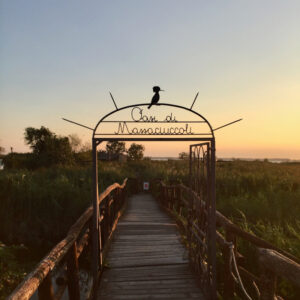
Today, Lake Massaciuccoli is one of Italy’s most important wetlands, also known for its connection to Giacomo Puccini. It offers nature trails, boat tours, wildlife oases, and cultural itineraries through historic villages and lakeside landscapes.
Tombolo Estate: Ancient Ports, Mediterranean Scrub, and Seaside Tourism
The Tombolo Estate, located between the Arno River and the Scolmatore canal, has had a strong maritime vocation since ancient times.
In Roman and medieval periods, it hosted an important Pisan port, later lost due to the progressive silting of the coastline—a process that contributed to the rise of the port of Livorno.
For centuries owned by the Archbishopric of Pisa, Tombolo remained largely covered by Mediterranean scrub and wetlands, without the deep transformations seen elsewhere under Florentine families. Only after Italian unification and ecclesiastical expropriation did land reclamation, reforestation, and infrastructure development begin.
Between the late 19th and 20th centuries, Marina di Pisa, Tirrenia, and Calambrone were established—significant examples of Italian seaside urban planning—alongside seaside colonies and later large tourist facilities.
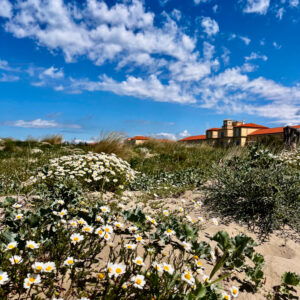
Today, Tombolo is the most urbanized sector of the Park, where equipped beaches, hotels, campsites, and cycling-pedestrian routes coexist with historic pine forests and protected natural areas.
Coltano Estate: Marshes, the Medici, and 20th-Century Reclamation
The Coltano Estate, located inland, represents one of the most emblematic examples of Tuscan landscape transformation.
Historically occupied by a vast marsh extending to the outskirts of Pisa, it was inhabited since prehistoric times and organized during the Roman era through sophisticated hydraulic systems.
In the 16th century, following the unification of Medici properties under Cosimo I, Coltano became a large estate mainly dedicated to hunting, grazing, and water management. The Medici Palace and the first route of the Navicelli Canal—crucial for connections between Pisa and the sea—were built here.
The definitive transformation occurred in the 20th century, when the large reclamation works of the Opera Nazionale Combattenti drained the marshes and created today’s agricultural landscape, with farms, rural houses, and an extensive canal network.
Today, Coltano is a rural area of great historical and environmental interest, ideal for cycling itineraries, guided tours, and routes combining agriculture, nature, and industrial archaeology.
